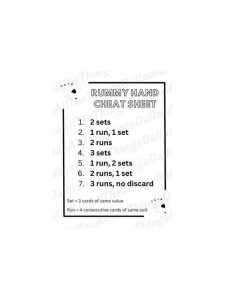
Rummy Endgame Threat Check Before Declaring

The endgame rewards verification. When a hand appears close, excitement can make an invalid group look complete or cause a player to ignore the safest discard. A threat check takes a few deliberate seconds before the final action.
Inspect each group independently. Confirm the cards follow the format’s rules, that any required pure sequence exists, and that a joker is being used in a permitted way. Do not rely on the visual arrangement alone. Say the group’s role in plain language before moving to the next one.
Then scan for loose cards. A card that feels attached may actually be outside the group, while a single forgotten card can change the score. Count the cards and compare the total with the format’s hand size. This simple count catches errors caused by rearranging quickly.
Make a threat check for the next turn if you are not declaring. Which discard could help an opponent? Which card leaves your own hand least exposed? Consider recent visible cards, but do not pretend to know another player’s exact route. Choose a discard that is defensible across more than one possibility.
Finally, verify the interface action. Check that you selected the intended card, that a confirmation screen shows the correct groups, and that you understand the penalty if the declaration is rejected. If the rules or screen are unclear, pause and consult the help information rather than clicking through pressure.
Practice the checklist with finished sample hands until it feels routine. The purpose is not to slow every turn; it is to create a reliable final gate when the cost of a small mistake is highest. A calm verification often matters more than one last ambitious draw.
If you use a physical notebook, point to each group as you check it. If you use an app, enlarge the cards or switch to a clearer layout before reviewing. Accessibility is part of accuracy: glare, a small screen, or a noisy environment can hide a card and create an avoidable mistake.
After a rejected or uncertain declaration, record the exact reason if the platform provides one. Do not immediately replay the hand while upset. Wait until you can inspect the groups calmly, then add the rule or counting step that would prevent a repeat. A final check becomes stronger when it is updated from real errors. The checklist should remain short enough to use consistently and specific enough to catch the mistakes that actually occur.