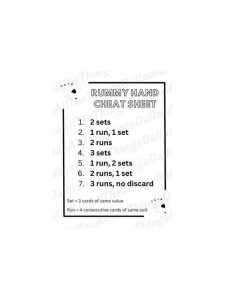
Rummy Comparison: Short Sequences Versus High-Value Sets
When a hand offers a short sequence and a high-value set, the correct choice is rarely determined by points alone. Each structure has a different risk profile. A short sequence may have several possible connectors, while a high-value set can reduce a large penalty but depend on one exact rank.
Start with completion paths. Count the cards that could improve each structure, not just the card you hope to draw. A sequence with two open ends may have more ways forward than a set waiting for one card. However, the sequence may also use cards that are useful elsewhere. Consider the complete hand, not an isolated group.
Next compare flexibility after completion. A sequence often creates a stable block that can no longer be used for another purpose. A set can be similarly fixed, but its surrounding cards may remain available for sequences. Ask which choice leaves more uncommitted cards and more plausible next decisions. Flexibility matters most when the deal is young or information is limited.
Then weigh penalty. High cards in a weak structure can be costly if the hand ends unexpectedly. If a set would remove several high points with one successful draw, it deserves attention even when its completion odds are narrower. Yet do not hold a high-value set forever if its required card is unlikely and your other route is improving.
Timing changes the comparison. Early in a deal, favor the structure with more routes and lower commitment. Near the end, a high-value reduction may be worthwhile if it also gives a realistic declaration path. Watch the table’s pace and visible discards, but remember that a safe-looking card can still be valuable to you.
Use a simple question: which structure improves the whole hand when it succeeds, and hurts the least when it fails? That answer is more reliable than “sequence is always better” or “discard high cards first.” Rummy rewards adaptable evaluation. Compare paths, not labels, and revisit the choice when a new card changes the balance.
Avoid comparing only best-case endings. Imagine an ordinary draw that improves neither group and leaves you needing another decision. The structure that remains manageable after an average miss is often preferable to one that looks unbeatable only when its exact card appears.