Rummy FAQ: Why Does Sorting Order Matter?
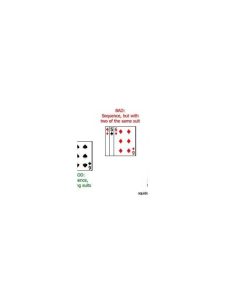
Sorting order matters because the hand is a visual problem as well as a mathematical one. When cards are arranged consistently by suit and rank, connected cards stand out and isolated cards become easier to question. A random layout forces you to rebuild the same information every turn, which increases the chance of overlooking a legal group or discarding the wrong card.
There is no single perfect arrangement. Some players group by suit first to reveal runs. Others place completed groups at one side, promising cards in the middle, and isolated cards at the other. The important feature is consistency. If your hand changes layout after every draw, you spend attention on rearranging rather than evaluating the new information.
Try a three-zone method. Put confirmed groups together, place active partial groups next, and keep unassigned cards at the far end. Within a partial run, order cards from low to high. Keep a pair visible as a pair, but do not let it look complete when it still needs a matching rank. This makes the difference between current value and future potential obvious.
Sorting also helps audit a declaration. You can inspect each group separately and ask whether it follows the rules. Watch for a card accidentally used in two places, a gap in a run, or a leftover card hidden between completed groups. The clearer the layout, the less likely a hurried confirmation will rely on a mistaken visual impression.
Practice the arrangement during casual or free play. If the table interface automatically sorts cards, learn how its order works and use manual grouping only when it helps. The aim is not to make the screen look tidy for its own sake. It is to make the next decision visible, repeatable, and less vulnerable to distraction.
Avoid sorting so aggressively that you hide uncertainty. A partial group should remain visibly partial, and cards that serve two plans should not be placed where they look committed to only one. Some players use a small gap between primary and backup groups for this reason. The best arrangement is the one that tells the truth about your options while making the weakest card easy to identify. If the hand is displayed in a narrow phone window, use a brief pause to confirm the order after every draw. Small screens can hide suit symbols or make adjacent cards look like one group. Increase text size or use a larger display when possible. Accessibility adjustments are part of good play because readable information supports accurate decisions.