Rummy Guide: Use a Waiting-Card Ladder
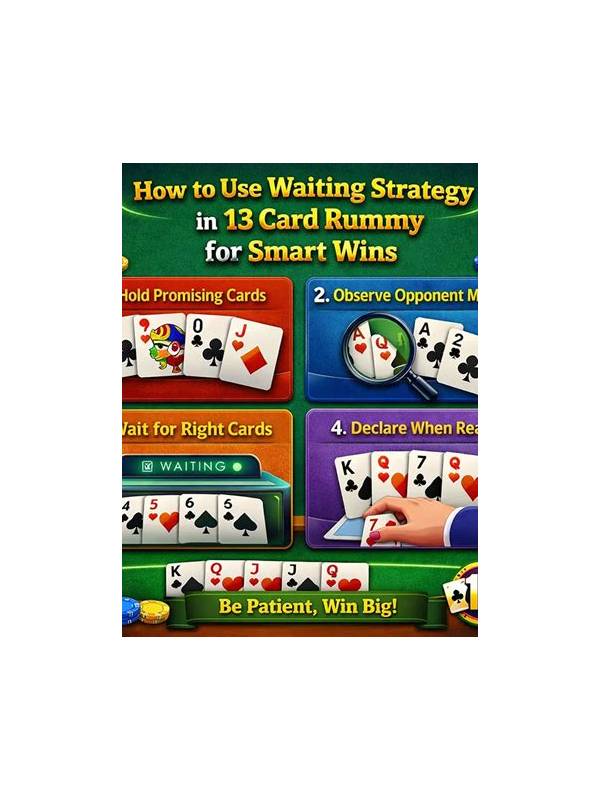
When a rummy hand contains several partial groups, it is easy to treat every missing card as equally promising. They are not. A waiting-card ladder is a simple way to rank those needs and decide which route deserves attention first.
Start by listing the cards that would improve each partial group. A four-five of hearts may want a three or six, while a pair of nines may want another nine. Write the possibilities mentally or on paper. Then rank each route by three questions: how many distinct cards help, how many are already visible, and whether the completed group would serve a legal hand structure.
The first rung is a broad, useful route. A middle-card sequence often has two directions and can accept more than one rank. The second rung is a narrower route, such as a set that needs one rank from the remaining deck. The lowest rung is a hope based on one exact card, especially when several copies have already appeared in discards or melds.
Do not count a card twice simply because it appears in two imagined plans. If one card would complete two groups, decide which group has the greater value before calling it a shared out. Otherwise, the apparent flexibility of the hand becomes exaggerated.
Update the ladder after every draw and discard. A visible card can remove a route, while a new connector can move another route upward. This keeps the method responsive rather than turning it into a fixed prediction. When the hand is close to completion, the ladder should also include risk: a route that leaves several high cards stranded may be worse than a slightly slower route with a clean fallback.
The ladder is not a promise that a particular card will arrive. It is a decision filter. Choose the route with the strongest combination of useful outs, low commitment, and acceptable penalty if it fails. If two routes remain close, keep one as a primary plan and treat the other as a backup rather than trying to build both at full strength.
Used consistently, this method turns vague optimism into a visible comparison. You still accept uncertainty, but you spend your next turn improving the route that has the best practical chance of becoming a complete and valid hand.
For example, a route needing one of six unseen cards may be more attractive than a route needing one of three, even if the smaller route looks cleaner. But also consider whether the six cards are spread across two ranks or whether some have already been exposed. The ladder is strongest when it combines count with context. Keep the calculation approximate; a quick ranking that guides action is more useful than a precise count that delays the turn.