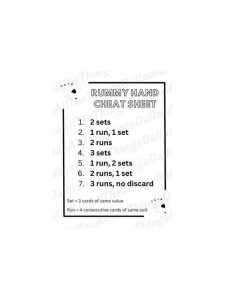
Rummy How-To: Finish a Hand Review With One Actionable Lesson
A hand review can easily become a long list of things you might have done differently. That list feels thorough but often changes nothing in the next session. Finish each review with one actionable lesson that describes a behavior you can observe and test.
Begin with the decision that mattered most. It may be the first commitment to a route, the discard that exposed a useful card, or the moment you failed to reassess. Do not start with the final outcome. A late loss may have been caused by an earlier choice, while a late win may have hidden an earlier risk.
Describe the decision without judgment. Write what cards were available, what information you had, and what alternatives you considered. Then identify the process issue, if one exists. Perhaps you did not count completion paths, ignored a deadline, or treated one opponent action as certain evidence. A precise description is easier to improve than “I played badly.”
Turn the issue into a rule with a trigger and an action. For example: “After two draws fail to improve a one-card route, compare it with the best backup before drawing again.” The trigger tells you when to remember the rule, and the action tells you what to do. Avoid lessons that depend on hindsight or require perfect prediction.
Keep the lesson small enough to use during play. If it contains five conditions, split it across future reviews. Practice one behavior for several hands, then assess whether it reduced rushed decisions or protected flexibility. A good lesson should produce an observable change, not just a reassuring sentence.
At the next review, check whether you applied it rather than whether the hand succeeded. If you followed the process and still lost, the experiment may remain valuable. If the rule was too difficult or created a new problem, revise it. Continuous improvement comes from testing habits, not from collecting dramatic conclusions about luck.
Store the lesson with the date and a short example, then stop the review. A clear endpoint makes practice repeatable and less likely to become self-criticism. Return to the table with one behavior to notice, not a demand to play perfectly.
Small, repeatable adjustments usually teach more than a dramatic promise to change everything.