Rummy FAQ: What Does a Clean Break Mean?
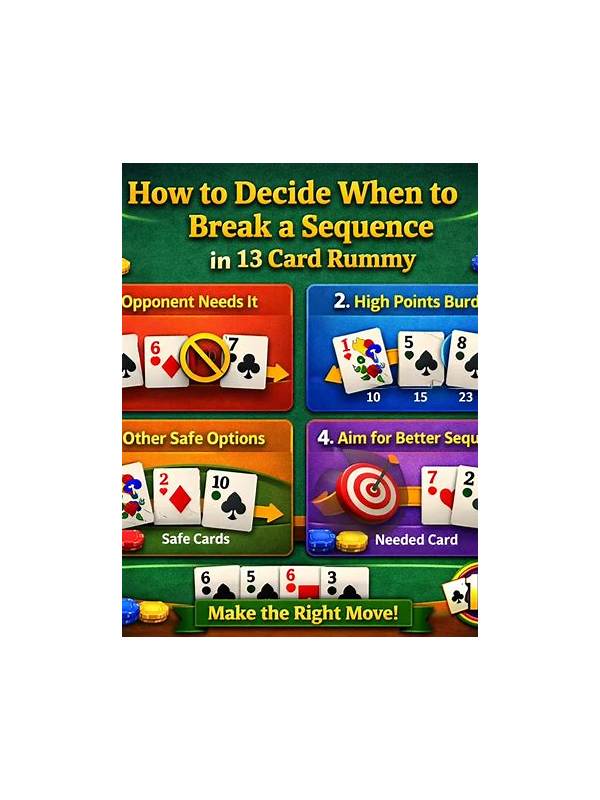
A clean break in rummy means abandoning a developing group before it consumes more useful cards. The phrase does not describe a special rule or a guaranteed winning move. It describes a disciplined decision: the expected benefit of continuing is now smaller than the flexibility gained by releasing the cards.
Why breaks are difficult
Players become attached to a plan because they spent turns building it. Two connected cards can look promising, especially when a third card would create a sequence. The problem is that the missing card may be too specific, already unavailable, or competing with a better arrangement. Continuing simply because the plan existed first can leave several unrelated cards stranded.
A clean break is easier when you name the condition that ends the plan. For example, you might decide that a two-card run will be dropped if the next useful draw does not arrive, or if a new card creates a stronger pure sequence elsewhere.
Signs that a break is sensible
Watch for three signs. First, the arrangement has only one realistic completion and no secondary use. Second, holding it prevents you from keeping a card that supports multiple groups. Third, the cards have become expensive relative to the penalty you would carry if the hand ended. One sign alone may not decide the matter, but several together deserve attention.
Also consider public information. If a needed card has appeared in the discard pile or in a visible completed group, the plan may be weaker than it looked at the start. Your estimate should change when the available information changes.
How to break cleanly
Choose the card with the fewest remaining connections and discard it when the rules and table situation permit. Then rearrange the remaining cards from scratch. Do not keep treating the abandoned pair as the center of the hand. A break is useful only if your thinking changes with it.
Sometimes a break means separating two cards rather than discarding one immediately. A middle card can remain useful for another sequence, while an outer card may be the true anchor of the failed idea. Examine the roles individually instead of removing a whole group automatically.
What a break is not
A clean break is not panic, and it is not proof that the original choice was foolish. Early information is incomplete. A reasonable plan can become poor after several draws. The skill is recognizing that change without defending the past.
In practice, review breaks by timing and information. Did you have a clear exit condition? What new fact made the plan weaker? Did the replacement plan create more options? These questions build judgment without relying only on whether the final result was a win. A clean break protects future decisions, which is often more valuable than preserving a familiar but narrow hope.